 Hover to view full
Womans Knowledge
Selina Numina
The living continuum of Tjukurpa, creation ancestors, and sacred custodianship
Living continuum
Dreaming encompasses past, present, and future in a single continuous time
Cultural authority
Artists only paint stories they have ceremonial rights and family lineage to depict
Songlines as maps
Paintings encode geographic knowledge, waterholes, and survival routes across desert country
The Dreaming, known across Central Desert languages as Tjukurpa or Jukurrpa, is not an ancient past frozen in memory. It is a living, present reality that unites ancestors, land, living people, and every ceremony.
In First Nations cosmologies, creation ancestors journeyed across unformed country, shaping creek beds, raising escarpments, depositing ochres, and generating flora and fauna. As they moved, they sang names into being and laid down immutable laws for kinship, obligation, and custodianship. These ancestral journeys did not end. They continue beneath the surface of the land, in the flow of water, in the movements of animals, and in the ceremonies that living people perform today. The Dreaming is therefore not a story about the past but a description of a present reality in which the ancestors remain active and present within country.
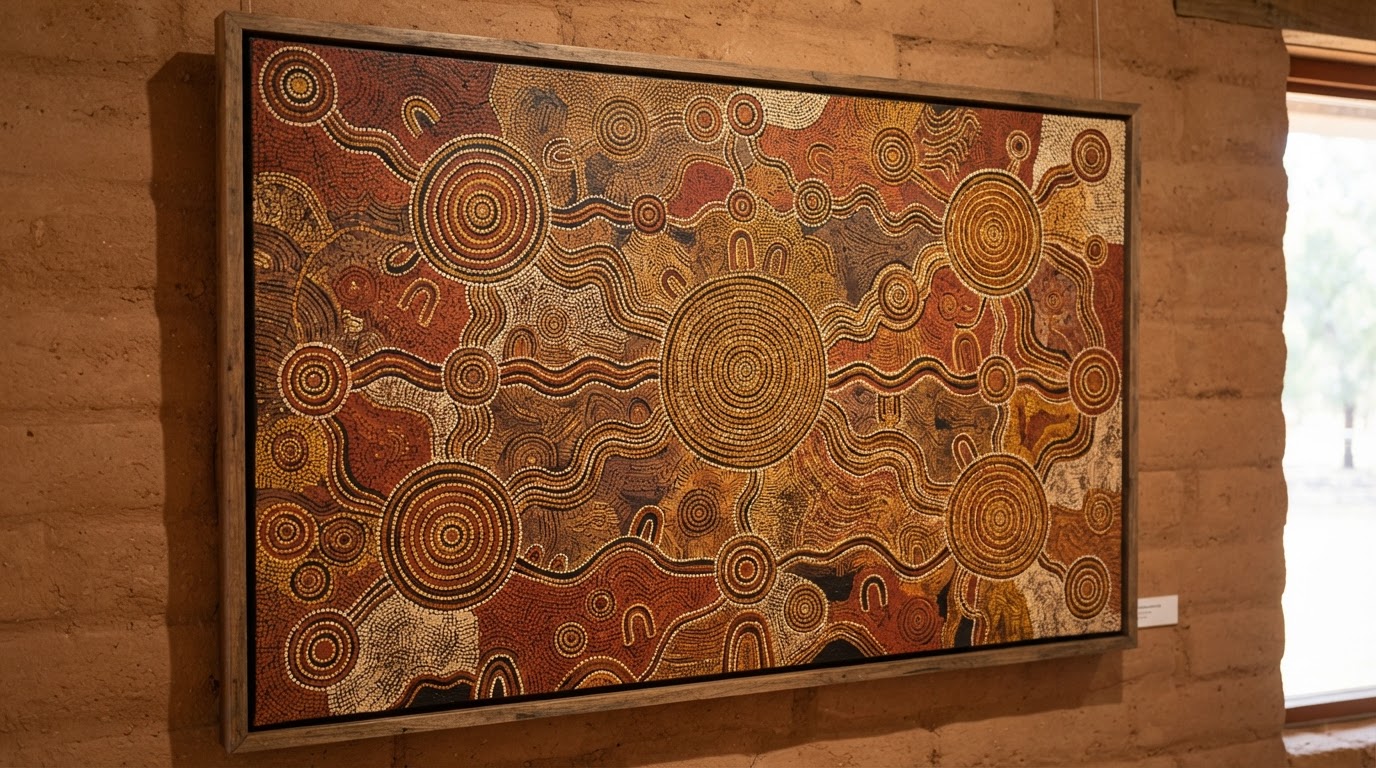
When an artist paints a Dreaming story, they are not improvising or creating a decorative impression. They are reproducing their inherited slice of law. An artist only paints the stories they have the cultural authority and ceremonial right to tell, handed down through maternal or paternal lines. The right to paint a story is the right to care for the country it describes, and the responsibility to keep that country alive through ceremony, song, and image. To paint without that authority would be a serious breach of law, not merely an artistic matter.
The canvas becomes a sacred document, a land deed, and a teaching narrative all in one. Every brush stroke preserves knowledge that has sustained communities across tens of thousands of years without interruption. The symbols encoded in the work, the concentric circles that mark waterholes, the lines that trace songlines, the U shapes that record gatherings, are not invented decoration but a visual language refined over millennia to carry the most important knowledge a people could hold, where to find water, how to behave toward kin, and how to keep the land alive.
The Dreaming encompasses law, kinship, ecology, and spirituality within a single, indivisible framework. It governs the relationships between people and country, between the living and the ancestors, and between humans and the animals and plants that share the land. The Rainbow Serpent, the Seven Sisters, the Emu and the Kangaroo, the Wandjina and the Mimi spirits, each carries a body of law that connects a particular country to the people who belong to it. These beings are not figures in a storybook but living presences whose power is felt in the land today.
Songlines carry the Dreaming across vast distances, linking the countries of different language groups into a single, continuous account. A songline encodes the features of the landscape in verse, with each passage corresponding to a waterhole, a hill, or a change in terrain. By singing the sequence, a traveller could navigate across country they had never seen, because the song itself was the map. The Dreaming stories held by one group connect to those of their neighbours, so that the whole continent is woven together by a network of songlines that have been sung for tens of thousands of years.
Custodianship is at the heart of the Dreaming. To hold a story is to hold a responsibility, to care for the sacred sites it describes, to perform the ceremonies that keep the country alive, and to pass the knowledge on to the next generation in the right way. The elders who carry this knowledge do so not as owners but as caretakers, answerable to their ancestors and to the generations to come. The survival of the world's oldest continuous living culture rests on this unbroken chain of custodianship, maintained through ceremony, song, and the living art that carries the Dreaming into the present.
The Dreaming is not finished. It continues to unfold in the present and into the future. When a painter takes up the stories of their country and places them on canvas, they are participating in a living tradition that has never been interrupted. The work they create is contemporary in its making but ancient in its meaning, a fresh statement of a story that has been told and retold for longer than any written record on earth. To stand before a Dreaming painting is to stand before a living thread of human history, as vital today as it was at its beginning.